
Quick Brief
Here’s a quick brief of Dubai off-plan payment plans before you read the full guide.
- Talk to us first so we can understand your budget, goal, timing, and payment comfort.
- Understand the full payment plan before comparing project prices.
- Check the booking amount, down payment, instalments, handover payment, and post-handover terms.
- Ask which fees are included and which fees are paid separately.
- Discuss whether paying more upfront or full cash may help you negotiate a better offer.
- Use only official developer, escrow, trustee, bank, or approved payment channels.
- Choose a plan that feels comfortable for your cash flow, not only attractive on paper.
- Ask our team to explain the plan clearly before you reserve a unit.
Read the full article below for the full details.
Payment plans are one of the biggest reasons many buyers choose off-plan property in Dubai. Instead of paying the full price at once, an off-plan buyer can usually pay in stages while the project is being built, and sometimes continue paying after handover if the developer offers a post-handover structure. This can make the buying process feel easier, especially for buyers who want to plan their cash flow, enter the Dubai property market earlier, or compare several projects before deciding.
At the same time, a payment plan should never be judged only by the headline. A plan can look attractive because the monthly instalment feels low, but the real question is whether the full structure matches your budget, timing, handover expectations, fees, and long-term plan. A good payment plan is not always the longest plan, the lowest first payment, or the plan with the biggest marketing headline. A good payment plan is the one that fits your situation clearly and comfortably.
This guide explains Dubai off-plan payment plans in simple language. It covers the main types of plans, the normal stages of payment, what fees to expect, how to compare two plans, what to ask before booking, and how our team can help you understand the numbers before you proceed.
What is an off-plan payment plan in Dubai?
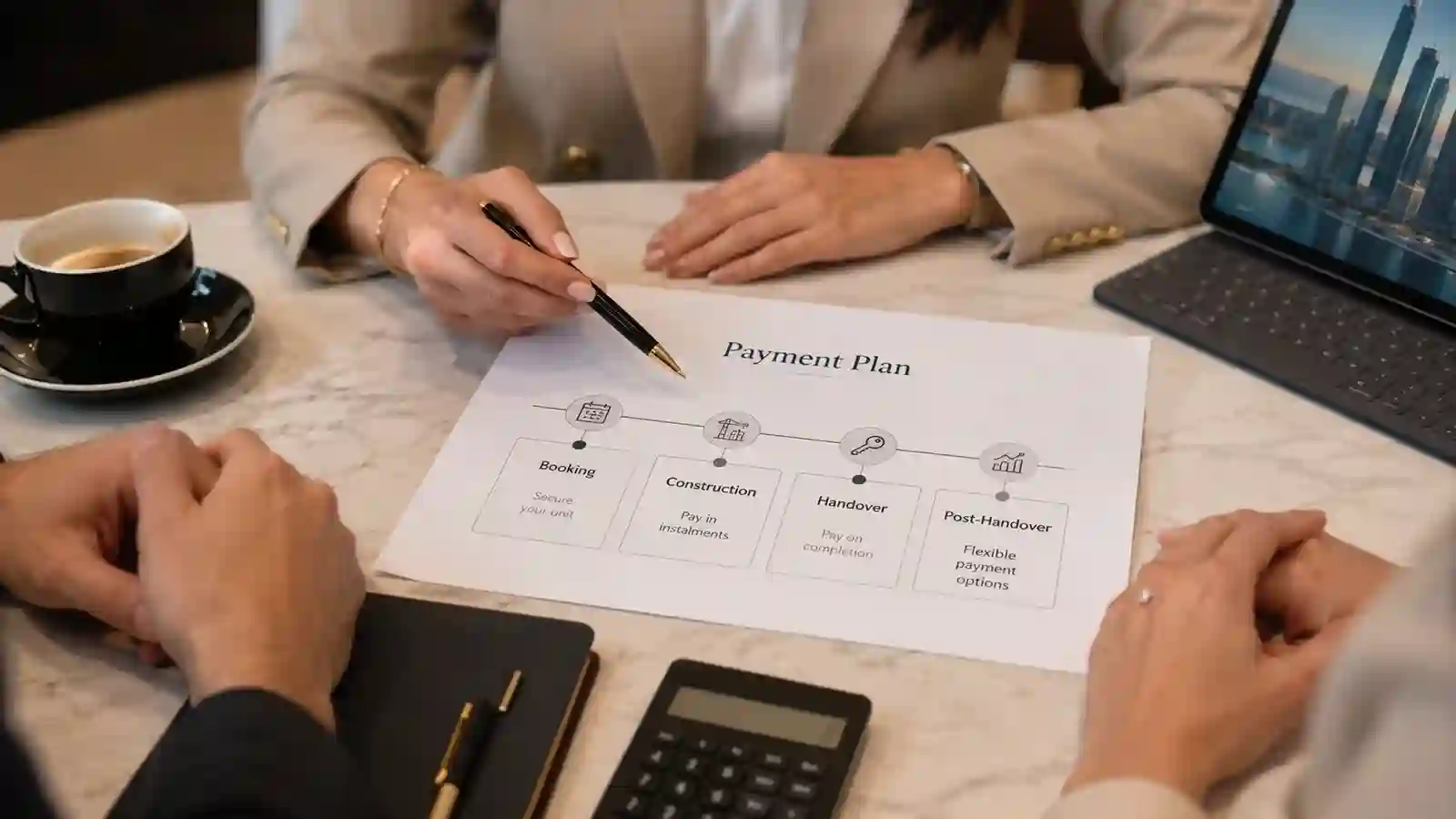
An off-plan payment plan is the schedule that explains how and when a buyer pays for a property that is still under construction or not yet handed over. The payment plan normally shows the amount due at each stage, such as booking, down payment, construction instalments, handover, and possible post-handover instalments.
For example, one project may ask for a larger amount early and smaller instalments during construction. Another project may allow a lower amount during construction but require a larger payment at handover. Another may offer payments after handover, giving the buyer more time to complete the full price. The exact structure depends on the developer, project, unit type, launch stage, current offer, and market conditions.
When you look at a payment plan, you are not only looking at numbers. You are looking at your future cash-flow calendar. Every payment date matters. Every fee matters. The handover amount matters. The rules for late payment, resale, cancellation, and transfer may also matter. This is why it helps to discuss the plan with someone who can explain it calmly before you sign or pay.
Why Dubai off-plan projects use payment plans
Off-plan payment plans make the buying process more flexible for many buyers. They allow a buyer to reserve a property before completion and pay in agreed stages. This can be useful for people who want to invest early in a project, plan their funds gradually, or buy a future home without paying the full purchase price immediately.
Developers also use payment plans to make launches easier to understand. A clear schedule helps buyers compare apartments, townhouses, villas, and other property types in a more practical way. Instead of only asking, “What is the price?”, a buyer can ask, “How much do I need now, how much do I pay during construction, and how much is due at handover?”
For foreign buyers, payment plans can be especially helpful because many off-plan purchases can often begin with basic buyer information and a valid passport copy, subject to the developer process and official payment requirements. This can make Dubai property easier to consider even when the buyer is outside the United Arab Emirates (UAE).
The main parts of a Dubai off-plan payment plan
Although every project can be different, most off-plan payment plans include a few common parts. Understanding these parts makes the full schedule much easier to read.
Booking amount or reservation payment
The booking amount is the first amount paid to reserve a unit. It may also be called a reservation payment, booking fee, or initial payment, depending on the developer wording. The purpose is usually to hold the selected unit while the buyer details, official forms, and next payment steps are completed.
Before paying, the buyer should confirm the exact unit, price, size, view, floor, payment schedule, payment channel, and reservation conditions. The buyer should also understand whether the booking amount forms part of the purchase price and what happens if the buyer changes their mind before signing the final documents.
Down payment
The Down Payment (DP) is an early payment that usually comes after the booking step or forms part of the initial payment stage. Some buyers think only about the down payment because it is the first larger amount they need to prepare, but it is only one part of the full payment plan.
A lower down payment can feel easier at the start, but the rest of the plan may require higher instalments later. A higher down payment can feel heavier at the beginning, but it may reduce the future balance or sometimes help the buyer discuss a better offer. This depends on the developer, project, unit, timing, and current availability.
Instalments during construction
Construction instalments are the payments made while the project is being built. These instalments can be linked to fixed dates, construction milestones, or a mix of both. The schedule should show when each instalment is due and how much must be paid.
This is the part of the plan where buyers should be realistic. A payment every few months may look manageable today, but the buyer should think about income, savings, currency exchange, other commitments, and future life events. A comfortable plan is better than a plan that causes stress later.
Handover payment
The handover payment is the amount due when the property is ready for handover, subject to the project and developer process. Some plans have a small handover payment. Others have a larger handover payment because the buyer paid less during construction.
Buyers should pay close attention to this number. A plan with low instalments before handover can still require a large final amount before receiving the keys. This is not automatically bad, but it must be planned properly.
Post-handover instalments
A post-handover payment plan allows part of the purchase price to be paid after the property is handed over, if the developer offers that structure. This can be attractive because the buyer may receive the property while still paying the remaining balance over time.
Post-handover plans can be useful, but they should be understood clearly. The buyer should check the payment dates, late-payment terms, whether the property can be rented during the post-handover period, whether transfer or resale is allowed before full payment, and whether any restrictions apply.
Common types of off-plan payment plans in Dubai
Dubai developers may structure payment plans in different ways. The names used in marketing can vary, but most plans fall into a few simple categories.
Construction-linked payment plans
A construction-linked plan connects payments to project progress. The buyer pays certain amounts as the construction reaches specific stages. This can help buyers feel that payments are connected to development progress, but the exact details depend on the official plan and developer documents.
When reviewing this type of plan, ask how milestones are defined, who confirms progress, and what happens if construction timing changes. The answer can vary by project, so it is better to confirm before relying on assumptions.
Time-linked payment plans
A time-linked plan uses fixed calendar dates or fixed intervals. For example, payments may be due every few months according to the agreed schedule. This type of plan is easy to read because the buyer can place each payment into a calendar.
The important point is to check whether the dates work for your personal cash flow. If you receive income monthly, quarterly, annually, or in another currency, the timing of the instalments can make a big difference.
Handover-heavy plans
Some plans allow the buyer to pay less during construction and more at handover. This can help buyers start with a lower early commitment, but it also means the buyer must prepare for a larger amount later.
This plan can work well for some buyers, especially those expecting funds later. It can be less suitable for buyers who may struggle to prepare a large handover payment. Our team can help you compare the handover amount against your realistic timing before you reserve.
Post-handover plans
Post-handover plans spread part of the price after handover. These plans can be popular because they may give buyers extra time. Some buyers also like the idea that the property may be usable or rentable while payments continue, subject to the developer terms and ownership process.
However, post-handover does not mean the property is free after handover. It means the buyer still has a payment obligation. The buyer should read the schedule carefully and understand what happens if a payment is late.
Short payment plans
A short payment plan usually means the buyer pays the full amount faster. This may suit buyers who have strong liquidity, want to complete payments quickly, or want to reduce long-term obligations.
In some cases, buyers who can pay more upfront, pay ahead of schedule, or pay in full cash may be able to discuss a possible discount or better commercial term. This is not guaranteed and depends on the developer, project, unit, timing, and current offer. It is always worth asking the right way before assuming the advertised plan is the only option.
Long payment plans
A long payment plan gives the buyer more time to complete payments. This can make the monthly or quarterly cash flow easier, but the buyer should still compare the full price, payment dates, handover balance, post-handover terms, and any conditions linked to the longer structure.
Longer does not automatically mean better. Sometimes a shorter plan with a better price may be more attractive. Sometimes a longer plan gives the buyer the comfort needed to proceed. The best choice depends on the buyer’s situation.
How the off-plan buying payment journey usually works
The exact process can vary, but the payment journey often follows a clear path. Understanding this path helps buyers feel more prepared.
Step 1: Discuss your budget and goal
Before comparing projects, speak with our team about your goal, budget, preferred area, timeline, and payment comfort. Are you buying for future living, investment, family use, rental income potential, capital preservation, or long-term Dubai exposure? Your goal changes the type of payment plan that may suit you.
For example, a buyer who wants a future home may care more about handover timing and community lifestyle. An investor may focus more on entry price, resale flexibility, rental readiness, and post-handover options. A buyer living abroad may want a simple remote process and clear payment channels.
Step 2: Select the project and unit
After narrowing the options, the buyer selects a project and unit. At this stage, the latest availability, price, payment plan, floor, view, size, and booking requirements must be confirmed. Off-plan inventory can change quickly, so buyers should rely on the current official availability, not old screenshots or outdated advertisements.
Step 3: Review the payment schedule
The payment schedule should be reviewed before payment is made. Buyers should check every line of the schedule, not only the first payment. Look at the booking amount, down payment, instalments, handover amount, post-handover amount, due dates, and any notes about fees.
This is where our team can make the process easier. We can explain the schedule in simple words, help you compare it with another project, and point out the questions you should ask before booking.
Step 4: Prepare buyer documents
Off-plan buyers usually need to provide buyer details and identity documents. For many foreign buyers, this often starts with a valid passport copy and basic information, subject to the developer’s current process. If the buyer is a UAE resident, Emirates ID and other details may also be requested.
The developer may also complete Know Your Customer (KYC) checks or compliance steps. These are normal parts of a professional property purchase process.
Step 5: Pay through the approved channel
Payments should be made only through official developer, escrow, trustee, bank, or approved channels. For off-plan projects, Dubai uses regulated project payment structures, and buyers should avoid informal payment requests or personal account arrangements.
If you are outside Dubai, ask clearly for the approved payment method, bank details, reference format, currency instructions, and receipt process. Keep proof of payment and ask our team if anything is unclear before sending funds.
Step 6: Sign the reservation form and main documents
After the booking stage, the buyer normally signs the reservation form and later the Sale and Purchase Agreement (SPA) or other project documents, depending on the developer’s process. The SPA is important because it sets out the agreed unit, price, payment schedule, handover terms, and buyer obligations.
Read the documents carefully. Ask questions early. If you do not understand a clause, ask for clarification before signing. This should not be scary; it is simply a normal part of buying properly.
Step 7: Complete registration steps
Dubai off-plan sales are usually registered through the relevant initial registration process. Buyers may hear terms such as Oqood, provisional registration, initial sale registration, or Dubai Land Department (DLD) registration depending on the project and stage.
You do not need to become an expert in every system name. The practical point is simple: make sure the purchase follows the official process, the registration-related fees are understood, and the buyer receives the correct documents and confirmations from the proper channel.
Step 8: Continue instalments until handover
After the main documents are signed, the buyer continues paying instalments according to the agreed payment plan. Keep a clear calendar of payment dates. Save receipts. Ask for statements when needed. If you plan to travel, change banks, or move money from another country, prepare early so payments are not delayed.
Step 9: Prepare for handover
As handover approaches, the buyer should prepare the handover payment, any final fees, inspection steps, snagging if applicable, service charge information, utility setup, and rental or move-in plan. The exact handover process depends on the developer and property type.
Step 10: Manage post-handover payments if applicable
If the plan includes post-handover instalments, keep the same discipline after receiving the property. Post-handover payments are still part of the purchase price. Make sure you understand the payment dates, accepted payment methods, late-payment rules, and whether any restrictions apply until the balance is fully settled.
Fees and extra costs buyers should understand
A payment plan usually explains the purchase-price instalments, but buyers should also understand fees and extra costs. Some fees may be shown separately from the payment plan. Some may be paid early. Some may appear closer to handover. Always confirm the latest amounts before booking because fees and service processes can vary.
Registration-related fees
Dubai property purchases normally involve registration-related fees. For off-plan projects, the buyer may see references to DLD fees, Oqood, initial registration, admin charges, or other related costs depending on the developer and transaction process. The exact wording and timing can vary.
Before booking, ask whether registration-related fees are due at the beginning, after signing, through the developer, through an approved payment channel, or in another official way. Do not assume these costs are included in the advertised price unless the offer clearly says so.
Developer administration fees
Some developers may charge administration, document, or processing-related fees. These are usually smaller than the main purchase payments but still matter when planning your total budget. Ask for the full payment breakdown so you do not focus only on the property price.
Payment method charges
If you are paying from abroad, your bank may apply transfer fees, exchange-rate costs, intermediary bank charges, or card-related charges. These costs may not be controlled by the developer. They can affect your real total cost, especially if you make several international transfers.
Mortgage and finance costs
Some buyers use bank finance, and some buyers pay directly through the developer payment plan. If you plan to use a mortgage or finance later, discuss it early because off-plan mortgage availability, timing, eligibility, valuation, and bank requirements can vary. Do not assume a future mortgage is certain to be approved.
Service charges after handover
After handover, owners usually need to plan for service charges and property running costs. These are separate from the purchase price and are part of owning a property. For investors, they matter when estimating future net rental performance. For end users, they matter for annual budgeting.
Taxes and personal obligations
Dubai property buyers often ask about taxes because rules in their home country may be very different. The simple answer is that you should not assume your home-country tax rules disappear when you buy abroad. If you have tax residence, reporting, inheritance, or cross-border questions, you should take qualified advice for your personal situation.
For the property payment plan itself, our role is to help you understand the developer schedule, property fees, payment channels, and purchase steps clearly. For personal tax advice, use a qualified tax adviser.
How to compare two Dubai payment plans properly
Many buyers compare payment plans too quickly. They see one plan with a smaller first payment and another plan with a higher first payment, then assume the smaller first payment is better. That is not always true. A smart comparison looks at the full picture.
Compare the total property price
First, compare the total purchase price. A more flexible plan may come with a different price than a shorter or cash-friendly plan. Sometimes the plan that looks easier month by month may not be the best overall value. Sometimes it is still the right choice because the buyer values flexibility. The point is to compare both price and timing together.
Compare the upfront amount
The upfront amount tells you how much cash you need to start. This may include booking, down payment, registration-related fees, and other initial amounts. Buyers should know the full first-stage requirement before making a decision.
Compare payments during construction
Look at the number of instalments and their due dates. If the plan requires regular payments during construction, place each payment into a calendar. This will show whether the plan is comfortable or too heavy.
Compare the handover amount
The handover amount is one of the most important lines in the plan. If it is large, the buyer should know how it will be funded. Will it come from savings, future income, property sale proceeds, mortgage, business income, or another source? The answer should be realistic.
Compare post-handover terms
If two projects both offer post-handover, do not assume they are the same. Check how long the post-handover period lasts, how much is payable after handover, how frequent the instalments are, what happens if payment is late, and whether resale or rental is affected.
Compare resale and transfer flexibility
Some buyers may want the option to resell before handover. If this matters to you, ask about the developer’s transfer rules, minimum payment required before resale, No Objection Certificate (NOC) process, and any charges. These rules can vary, so confirm before buying.
Compare the real comfort level
A payment plan must feel comfortable after the excitement of booking is gone. The best plan is the one you can follow calmly. If a plan requires stretching too much, discuss alternatives before reserving.
Can paying more upfront or full cash get a better offer?
Sometimes, yes, it may help. In some cases, buyers who can pay a larger amount upfront, pay ahead of schedule, choose a shorter payment plan, or pay full cash may be able to discuss a possible discount, better price, fee support, upgrade, or stronger commercial offer. This depends on the developer, project, unit, launch stage, inventory level, timing, and current campaign.
This should always be presented as a discussion, not a promise. No buyer should assume that full cash automatically creates a discount. Some developers may offer a clear cash price. Some may not. Some may have special offers only on selected units. Some may prefer a certain payment structure. The right approach is to ask professionally and compare the final written offer.
This is where DubaiHome.ai can help. If you have strong liquidity or want to pay faster, talk to us before choosing the standard plan. We can help you ask whether a better structure may be available and compare the written options clearly.
What buyers should check before booking an off-plan unit
Before paying any booking amount, buyers should confirm the key details. This does not need to feel complicated. Think of it as a simple buyer checklist.
- Exact project name and location.
- Developer name and official project details.
- Unit number, property type, size, floor, view, and layout.
- Total purchase price.
- Booking amount and payment deadline.
- Down payment amount and due date.
- Full payment schedule until handover.
- Any post-handover payment schedule.
- Registration-related fees and when they are payable.
- Developer admin or document charges.
- Approved payment channel and bank details.
- Reservation form conditions.
- SPA timing and signing process.
- Late-payment rules.
- Resale or transfer rules if important to you.
- Expected handover timing, written in the official documents.
Ask our team to review these points with you in simple language before you book. A few minutes of clarity before payment can make the full buying journey much more comfortable.
Payment plans for buyers outside Dubai
Many overseas buyers are interested in Dubai off-plan property because the process can often begin remotely, subject to the developer and official requirements. In many cases, a buyer can start by sharing a valid passport copy, buyer details, selected unit, signed reservation form, and approved payment proof.
The main thing for overseas buyers is clarity. You should know exactly how to pay, which reference to use, what currency is accepted, how receipts are issued, and which documents you will receive after payment. Time-zone differences, bank transfer delays, and exchange rates should also be considered.
If you are buying from abroad, talk to us first. We can explain the project, payment plan, required documents, official channels, and next steps so the process feels organized from the beginning.
Payment plans for UAE residents
UAE residents may also use developer payment plans for off-plan purchases. The process may feel easier because the buyer may already have Emirates ID, a UAE bank account, and easier access to local payment channels. However, the same principles still apply: understand the full schedule, check the fees, confirm the handover amount, and make sure the plan suits your real cash flow.
UAE residents who plan to use mortgage finance should discuss this early. A developer payment plan is not the same as a bank mortgage. If you expect to finance a future payment or handover amount, check the bank route before relying on it.
Official payment channels, escrow, and buyer confidence
Dubai off-plan property has official systems and regulated processes designed to organize project payments and registration. Buyers may hear terms such as escrow account, DLD, Real Estate Regulatory Agency (RERA), Dubai REST, Oqood, or initial registration.
You do not need to become an expert in every term. The buyer-friendly rule is simple: pay only through approved channels, keep your receipts, and make sure the purchase follows the official process. Do not send money to personal accounts or unclear payment routes.
For off-plan projects, the escrow account is especially important because it is connected to the project payment structure. Buyers can also use official tools and confirmations where relevant to check project-related information. Our team can guide you on what to ask for without overwhelming you with unnecessary details.
Common mistakes buyers can avoid
The goal is not to scare buyers. Most payment-plan confusion comes from moving too fast or reading only the headline. These common mistakes are easy to avoid with the right explanation.
Looking only at the monthly amount
A low monthly or quarterly amount can look attractive, but always check the full price, handover balance, fees, and post-handover obligations.
Ignoring the handover payment
The handover payment can be a major part of the plan. If it is large, prepare early and understand your funding source.
Assuming fees are included
Some advertised prices and plans do not include every fee. Ask what is included and what is separate.
Assuming all post-handover plans are the same
Post-handover structures can vary. Check the dates, amounts, rules, and restrictions.
Waiting too long to ask about discounts
If you are considering full cash, a larger upfront payment, or faster payment, discuss it before booking. It is easier to compare options before documents are prepared.
Not saving receipts and documents
Keep a clean folder with payment receipts, signed forms, SPA, registration confirmations, and all official communication.
Simple examples of different buyer situations
Every buyer is different. These examples are generic, but they show how payment-plan choices can change depending on the buyer’s situation.
Example 1: The buyer who wants low early payments
This buyer wants to enter the market but prefers to keep early cash flow light. A plan with lower construction payments may help, but the buyer must check the handover amount carefully. If the handover payment is large, the buyer needs a realistic plan for that future amount.
Example 2: The buyer who has strong cash available now
This buyer may prefer a larger upfront payment or full-cash discussion if it can improve the offer. The buyer should ask whether a better price or special term is available and compare the final written options.
Example 3: The overseas buyer
This buyer wants a simple process from outside Dubai. The most important points are official payment instructions, clear documents, passport requirements, signing process, receipts, and support during each step.
Example 4: The investor thinking about resale
This buyer wants flexibility before handover. The buyer should ask about transfer rules, minimum payment required before resale, NOC requirements, and any fees or restrictions.
Example 5: The future end user
This buyer cares about handover, community, layout, lifestyle, and long-term ownership costs. The payment plan should match the expected move-in timeline and family budget.
Questions to ask before choosing a payment plan
- What is the total purchase price?
- How much do I need to pay today to reserve the unit?
- When is the down payment due?
- What are the exact instalment dates?
- How much is due at handover?
- Is there any post-handover payment period?
- Are registration-related fees included or separate?
- Are there any developer admin fees?
- Can I pay by bank transfer, card, cheque, or another approved method?
- Can overseas buyers pay from outside the UAE?
- Is there a possible better offer for full cash or larger upfront payment?
- What happens if I miss a payment?
- Can I sell before handover?
- What documents will I receive after payment?
- Who can explain the SPA and payment schedule before I sign?
Glossary of useful payment-plan terms
Down Payment (DP)
The early payment made after booking or as part of the initial purchase stage. It forms part of the buyer’s payment plan.
Expression of Interest (EOI)
An Expression of Interest (EOI) is sometimes used before or during a launch to show serious buyer interest. It does not always work the same way for every project, so the buyer should confirm the rules before paying.
Sale and Purchase Agreement (SPA)
The Sale and Purchase Agreement (SPA) is the main contract between the buyer and developer. It usually includes the property details, price, payment schedule, handover terms, and obligations.
Dubai Land Department (DLD)
The Dubai Land Department (DLD) is the main Dubai government authority connected to property registration and real estate services.
Real Estate Regulatory Agency (RERA)
The Real Estate Regulatory Agency (RERA) is part of Dubai’s real estate regulatory framework and is commonly mentioned in relation to developer, broker, project, and escrow-related matters.
Oqood
Oqood is commonly connected with the registration process for off-plan property transactions. Buyers may see it mentioned in relation to initial registration or provisional sale registration.
Escrow account
An escrow account is a regulated project account used for off-plan project payments. The practical buyer point is to use approved payment channels and keep proof of payment.
Handover
Handover is the stage when the property is ready to be delivered to the buyer, subject to the developer process, final payments, inspections, and required documents.
Post-handover payment plan
A post-handover payment plan allows part of the property price to be paid after handover, if offered by the developer and agreed in the documents.
No Objection Certificate (NOC)
A No Objection Certificate (NOC) may be required in certain resale, transfer, or developer-related processes. If resale flexibility matters to you, ask about the NOC process before buying.
How DubaiHome.ai can help you compare payment plans
Payment plans can be simple when someone explains them clearly. Our team can help you compare options without pressure. We can review your budget, preferred payment comfort, location interest, property type, and buying goal, then help you understand which plan may fit you better.
We can also help you ask the right questions before booking, such as whether fees are included, whether a full-cash or larger-upfront discussion is possible, how much is due at handover, and whether the plan suits an overseas buyer or UAE resident.
The goal is not to push you into the longest plan or the shortest plan. The goal is to help you choose a plan that feels clear, manageable, and suitable for your situation.
Final buyer checklist
- Confirm the latest price and availability.
- Ask for the full payment plan in writing.
- Check booking, down payment, construction payments, handover, and post-handover amounts.
- Understand all fees before paying.
- Ask if better terms may be discussed for larger upfront payment or full cash.
- Use only approved payment channels.
- Keep all receipts and signed documents.
- Check resale or transfer rules if that matters to your plan.
- Plan handover and post-handover payments early.
- Speak with our team before booking so everything is clear.
FAQs about Dubai off-plan payment plans
What is a payment plan for Dubai off-plan property?
It is the schedule that shows how the buyer pays for the property over time. It normally includes booking, down payment, construction instalments, handover payment, and sometimes post-handover payments.
Are payment plans the same for every Dubai off-plan project?
No. Payment plans vary by developer, project, unit type, launch stage, current offer, and market conditions. Always confirm the latest written plan before booking.
Can foreign buyers use Dubai off-plan payment plans?
Yes, foreign buyers can commonly buy off-plan property in Dubai and use developer payment plans, subject to the developer process, official documents, approved payment channels, and current requirements.
Do payment plans include Dubai property fees?
Not always. Some fees may be separate from the purchase-price payment plan. Ask whether registration-related fees, admin fees, and other charges are included or paid separately.
Are post-handover payment plans better?
They can be helpful for some buyers because part of the price is paid after handover. But they are not automatically better. You should check the total price, payment dates, rules, restrictions, and your comfort level.
Can I get a discount if I pay full cash?
Sometimes a larger upfront payment, faster payment, or full-cash option may help a buyer discuss a possible better offer. It is not guaranteed and depends on the developer, project, unit, timing, and current availability.
What happens if I miss an instalment?
The consequences depend on the contract, payment schedule, developer process, and applicable rules. Ask about late-payment terms before signing, and communicate early if you expect a delay.
Can I resell an off-plan property before handover?
It may be possible in some cases, subject to the developer’s transfer rules, minimum payment requirement, NOC process, buyer eligibility, and current market conditions. Confirm this before buying if resale flexibility is important to you.
Should I choose the longest payment plan?
Not automatically. A longer plan may improve cash flow, but you should compare the full price, fees, handover amount, post-handover obligations, and your own comfort level.
Should I talk to DubaiHome.ai before choosing a payment plan?
Yes. Talk to us before you reserve a unit so we can understand your budget, goal, and timing, then explain the payment plan in a simple way and help you compare your options.
Final summary
Dubai off-plan payment plans can make property buying more flexible and easier to plan, but the best plan is not always the one with the lowest first payment or the longest schedule. A smart buyer checks the full structure: booking amount, down payment, instalments, handover payment, post-handover terms, fees, payment channels, resale rules, and personal cash flow.
If you can pay more upfront, pay ahead of schedule, or consider full cash, it may also be worth discussing whether a better offer is possible. This is never guaranteed, but it can be an important question to ask before booking.
Most importantly, do not choose a plan alone from a headline. Talk to DubaiHome.ai first so our team can understand your situation, explain the payment schedule clearly, and help you choose a Dubai off-plan project with more confidence.
 Buying Process, Foreign Buyers
Buying Property in Dubai
A clear Dubai property buying guide for overseas buyers, non-UAE residents, and UAE residents, covering documents, booking, SPA, DLD registration, payments, and handover.
 Buying Process, Off-Plan, Foreign Buyers
Buy from Abroad
A friendly overseas buyer guide to buying off-plan or ready property in Dubai, including documents, payments, POA, rental management, and visa basics.
 Buying Process, Fees & Taxes, Off-Plan, Foreign Buyers, Dubai Property
AED 0 Buyer Fee
Learn how our AED 0 buyer fee works for Dubai off-plan and ready properties bought directly from developers, and what guidance buyers receive before committing.
Important note
This guide is for general information only and should not be treated as legal, financial, tax, immigration, mortgage, or investment advice. Dubai property rules, fees, visa requirements, developer terms, prices, availability, payment plans, and authority procedures may change. Please contact DubaiHome.ai so our property consultant can help you verify the latest details with the relevant authority, developer, trustee, bank, or qualified advisor before you make a decision.